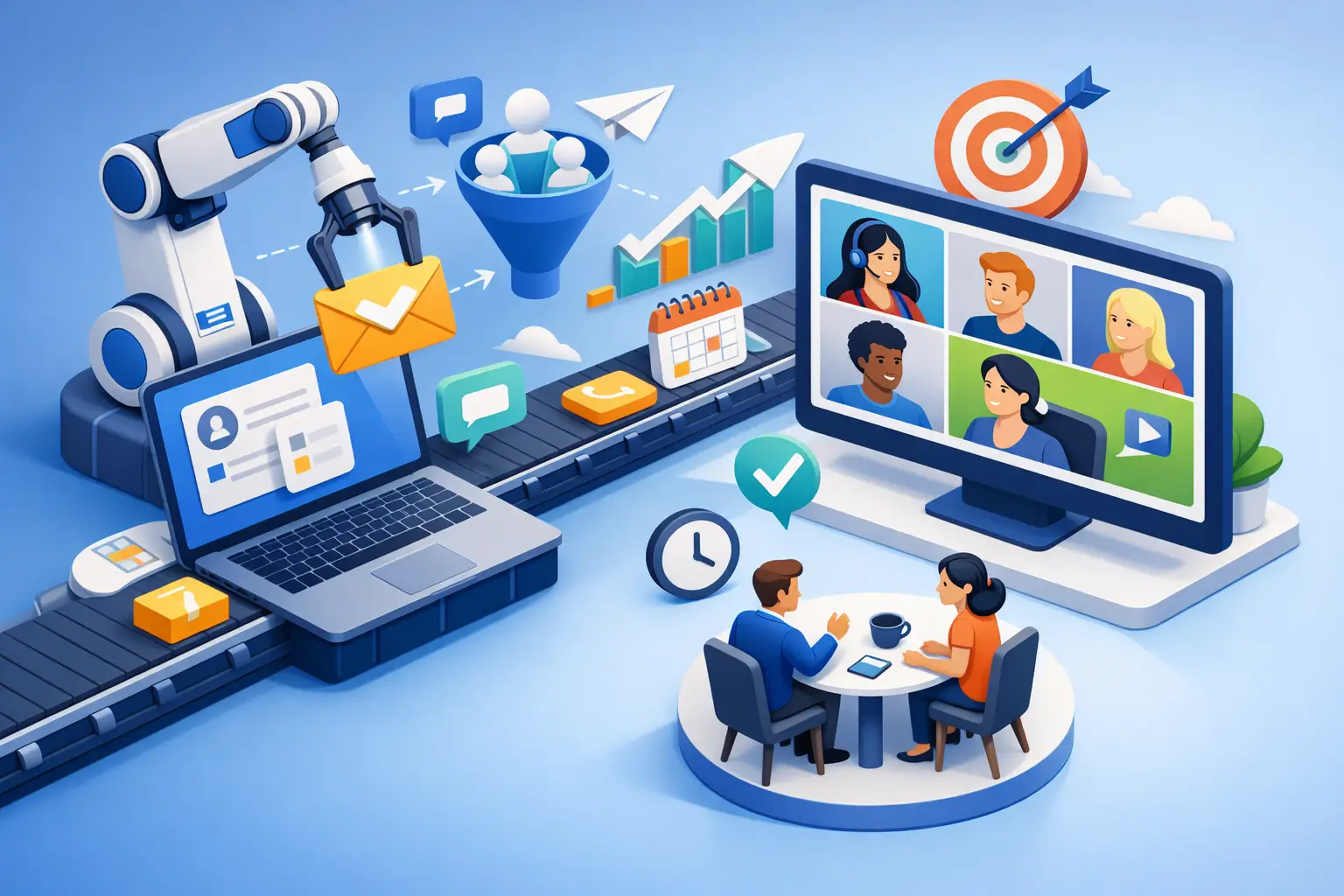
Most sales teams do not have a lead problem. They have an execution problem. Leads sit untouched, follow-ups go out late, reps cherry-pick easy prospects, and booked meetings depend too much on who remembered to send the next message. That is where sales automation stops being a nice-to-have and starts acting like infrastructure.
For companies trying to grow pipeline without hiring a full SDR team, the real value is not sending more emails for the sake of activity. It is creating a system that reaches the right prospects, follows up on time, qualifies interest, and turns attention into booked conversations. When that system runs consistently, revenue gets less dependent on manual effort.
What sales automation is really supposed to do
A lot of teams treat sales automation like a volume tool. They buy software, queue up a few sequences, and hope more outbound sends will fix a weak pipeline. Usually it does not. More activity only helps if the process behind it is sound.
At its best, sales automation handles the repetitive work that slows down prospecting and follow-up. That includes list engagement, message sequencing, lead routing, reply handling, meeting scheduling, and persistence over time. It gives the business a way to maintain sales motion every day, not just on the days when the team has enough bandwidth.
That matters because consistency is where most pipelines break. A founder can do outbound for a week. A sales manager can push the team to clean up follow-ups for a month. Neither is a reliable operating model. Automation is.
Where manual sales work usually breaks down
The first issue is speed. A new lead comes in, but the response does not happen until hours later, or the next day. By then, attention is gone. In outbound, timing matters even more because the market is crowded and every delay lowers reply rates.
The second issue is coverage. Human teams naturally focus on whatever feels urgent. That means older leads, colder prospects, and long-tail follow-ups get ignored. Yet a large share of meetings comes from people who did not respond to the first or second touch.
The third issue is cost. Hiring SDRs adds salary, management time, onboarding, tools, and turnover risk. For many small and mid-sized businesses, that overhead is hard to justify before the pipeline is already stable. This is why so many companies get stuck between wanting more outbound and not wanting the burden of building a full prospecting function.
Sales automation works best when it owns a clear outcome
There is a big difference between automating tasks and automating results. Task automation sends emails, updates fields, or triggers reminders. Useful, but limited. Outcome-focused sales automation is built around a business goal, such as qualified conversations booked on the calendar.
That shift changes how the whole system is designed. Instead of asking whether a tool can send messages, the better question is whether it can keep the sales process moving without constant human intervention. Can it handle outreach at scale, respond to intent signals, follow up with discipline, and push prospects toward a meeting?
If the answer is no, the team still has a labor problem. It just has better software.
What a practical sales automation system looks like
A strong setup usually starts with audience targeting. If the list is weak, automation will only fail faster. The next layer is message logic - not generic spam, but outreach that matches the offer, market, and buying context. Then comes cadence. Most deals do not start with one perfect email. They come from repeated, timely touches across a realistic follow-up window.
After that, the system needs to handle responses intelligently. Positive replies should move toward scheduling. Ambiguous replies should get routed for clarification or qualification. No-shows and non-responders should not disappear. They should re-enter the process with the right timing.
This is why agent-based systems are gaining traction. Instead of acting like a static tool, they function more like a digital sales operator. They do the repetitive work, keep the process running, and reduce the drop-off that happens between interest and booked appointment.
Why always-on outreach changes the economics
Sales teams are not available 24/7. Prospects are inconsistent, inboxes are crowded, and attention shows up at odd hours. If your process depends on someone being online, checking a CRM, and remembering the next step, meetings get lost.
Always-on sales automation changes that. It keeps outreach active, follows up without gaps, and responds faster than a manual workflow can. For real estate, agencies, and service businesses, that speed can be the difference between booking the conversation and losing it to whoever replied first.
It also changes the cost structure. Instead of adding people every time volume increases, businesses can scale activity with a much leaner operation. That does not mean human sellers disappear. It means their time gets reserved for conversations that actually require judgment, persuasion, and deal movement.
The trade-offs leaders should think about
Sales automation is not magic, and treating it that way creates expensive disappointment. Bad targeting still produces bad outcomes. Weak offers still get ignored. If your market does not respond to outbound, no workflow will fix that by itself.
There is also a brand risk if the automation feels careless. Prospects can spot low-quality outreach quickly. Generic messaging, poor timing, and irrelevant follow-up do more harm than sending nothing at all. Automation should increase precision, not remove it.
Then there is the internal trade-off. Some teams want full control over every touchpoint, and that can make automation harder to implement well. If leadership insists on reviewing every message, every response, and every workflow adjustment, the system never becomes operationally useful. The point is not to create another dashboard to babysit. The point is to remove manual drag from pipeline generation.
How to know if your business is ready for sales automation
You are likely ready if you already know who you sell to, what problem you solve, and what kind of meeting you want booked. You are also ready if your current problem is capacity, consistency, or follow-up discipline rather than a total lack of product-market fit.
This tends to fit businesses with a clear service offer, sales-led SaaS companies, agencies, brokers, and local operators who need a steady flow of conversations. It is especially useful when leadership is tired of depending on founder-led outreach or underperforming SDR workflows.
It may not be the right move if your offer changes weekly, your audience is unclear, or your close process is still chaotic. In that case, automation can expose operational problems faster, but it will not solve them for you.
What to measure beyond open rates
The wrong metrics make average systems look busy. Open rates, send counts, and raw reply volume can all go up while revenue stays flat. The better lens is movement toward pipeline.
Look at booked meetings, qualified conversations, speed to lead, response coverage across the full funnel, and cost per opportunity created. Those numbers tell you whether the system is reducing labor while increasing output.
This is also where many businesses start rethinking the old SDR model. If an automated system can deliver a predictable flow of meetings at a lower operating cost, the comparison is no longer about software versus human effort. It becomes a question of efficiency per booked opportunity.
That is why companies are moving toward practical AI sales operators instead of stacking more point solutions. They want a system that does the work, not another tool the team has to manage. Apps2Grow is part of that shift, with agent-based systems built to handle outreach and appointment setting as a revenue function, not a side task.
The real standard for sales automation
Sales automation should not be judged by how advanced it sounds. It should be judged by whether it creates more qualified conversations with less manual work. If it cannot do that, it is just activity wrapped in new language.
The businesses that win with automation are usually the ones that stay practical. They care about pipeline coverage, follow-up consistency, and meeting volume. They do not need a futuristic pitch. They need a system that keeps working when the team is busy, short-staffed, or trying to grow without adding payroll.
If your pipeline still depends on memory, hustle, and whoever had time to follow up today, you do not need more pressure on the team. You need a sales system that shows up every day, does the work, and keeps booking the next conversation.